
The Next Chapter, T—NC, is a strategy practice that designs organizations through inflection points.
Strategy, as I define it, is the act of architecting outcomes using rigor and creativity.
I help clients trying to grow, focus, and reinvent themselves in climate tech, hospitality, and civic planning sectors. I deliver decision-making frameworks that move them from today to their optimal state.
Because frameworks, unlike insight reports, are meant to be used. They aren’t a final deliverable, they’re an evergreen lens used to make every choice clear and actionable—from what to say in an about us story to portfolio management, distribution networks, internal alignment, talent acquisition, and investment raise strategies. Frameworks that guide decisions about where to focus, what to ignore, how to grow, and when to take that next step (or leap) forward.
The world would be a different place if design was given credit not as a practice, but as a tool to be used on any number of problems. Imagine if every company had a Chief of Design. Or if we elected a Secretary of Design to serve local government.
People whose job it is to think deeply with logic and empathy at the same time. To find universality while still appreciating nuance. To find beauty in the mundane and to id solutions to problems we might not even realize we have yet.
Because you can design anything: a chair, a cure, an intersection, an interaction, a menu, a meeting, a feeling. Design is a tool to imagine better, shared futures. Applied, it inspires new ways of living, and new futures to live in. And I intend to do just that.
The T—NC methodology works in two ways:
Designing for Commercialization
Commercialization is how ideas find traction. Getting to an ideal state means designing for traction in talent, scalability, credibility, and funding. Without all four elements, commercialization (the ideal future) will never happen.
For founders in climate tech, deep tech, health tech, or AI infrastructure where underlying technology is novel and complex, commercialization means demonstrating sector value to unlock financial predictability.
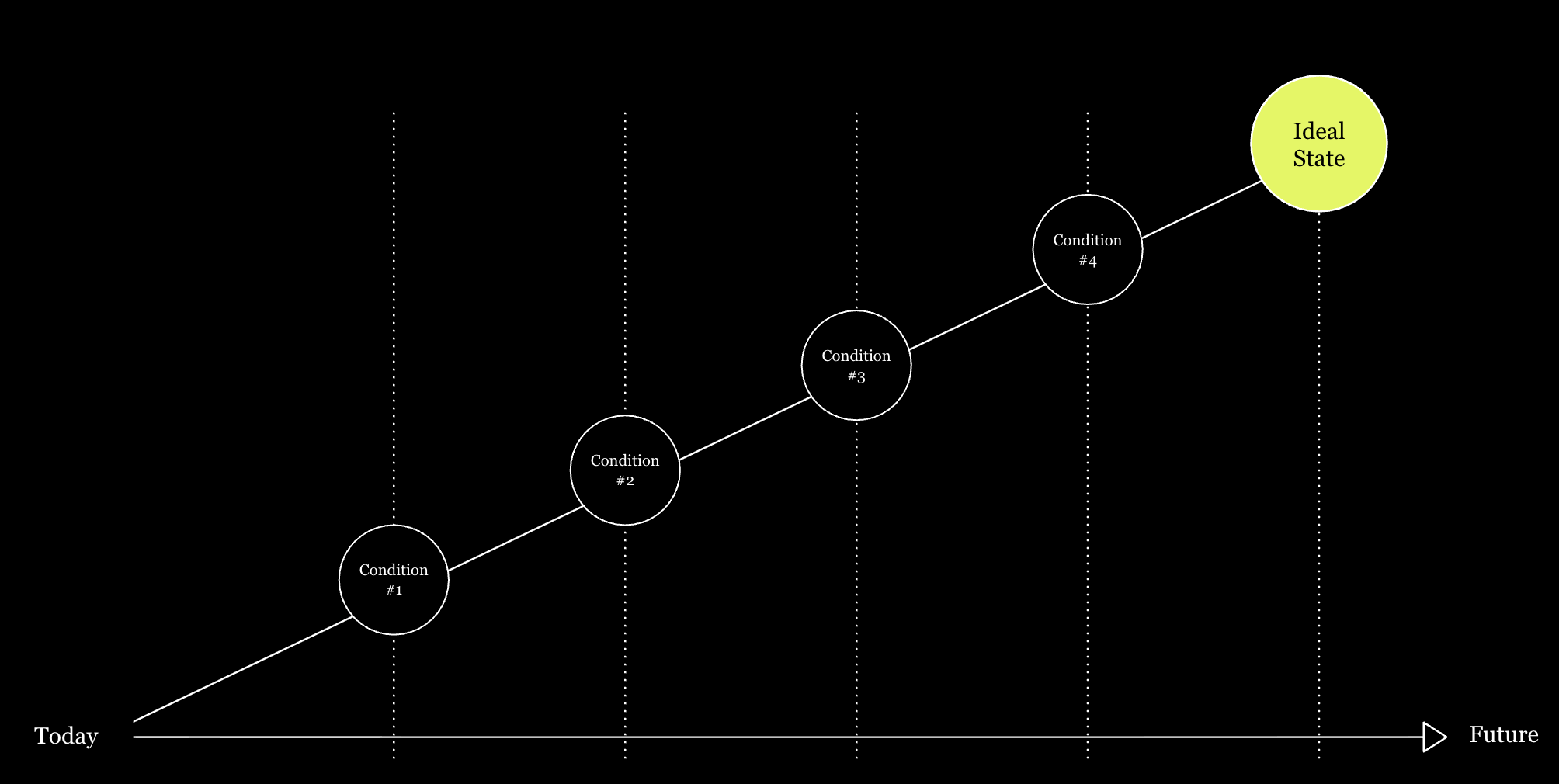
This approach starts by imagining an ideal state 5+ years in the future, and then maps a series of conditions that must be met in order for that state to be achieved. Conditions are specific and designable; influenced through signals, experiences, partnerships, proof, and strategic sequencing
This methodology creates a roadmap of milestones to be designed and executed between now and that ideal. The deliverable is a decision making compass to be used and activated again and again.
2. designing for Cohesion
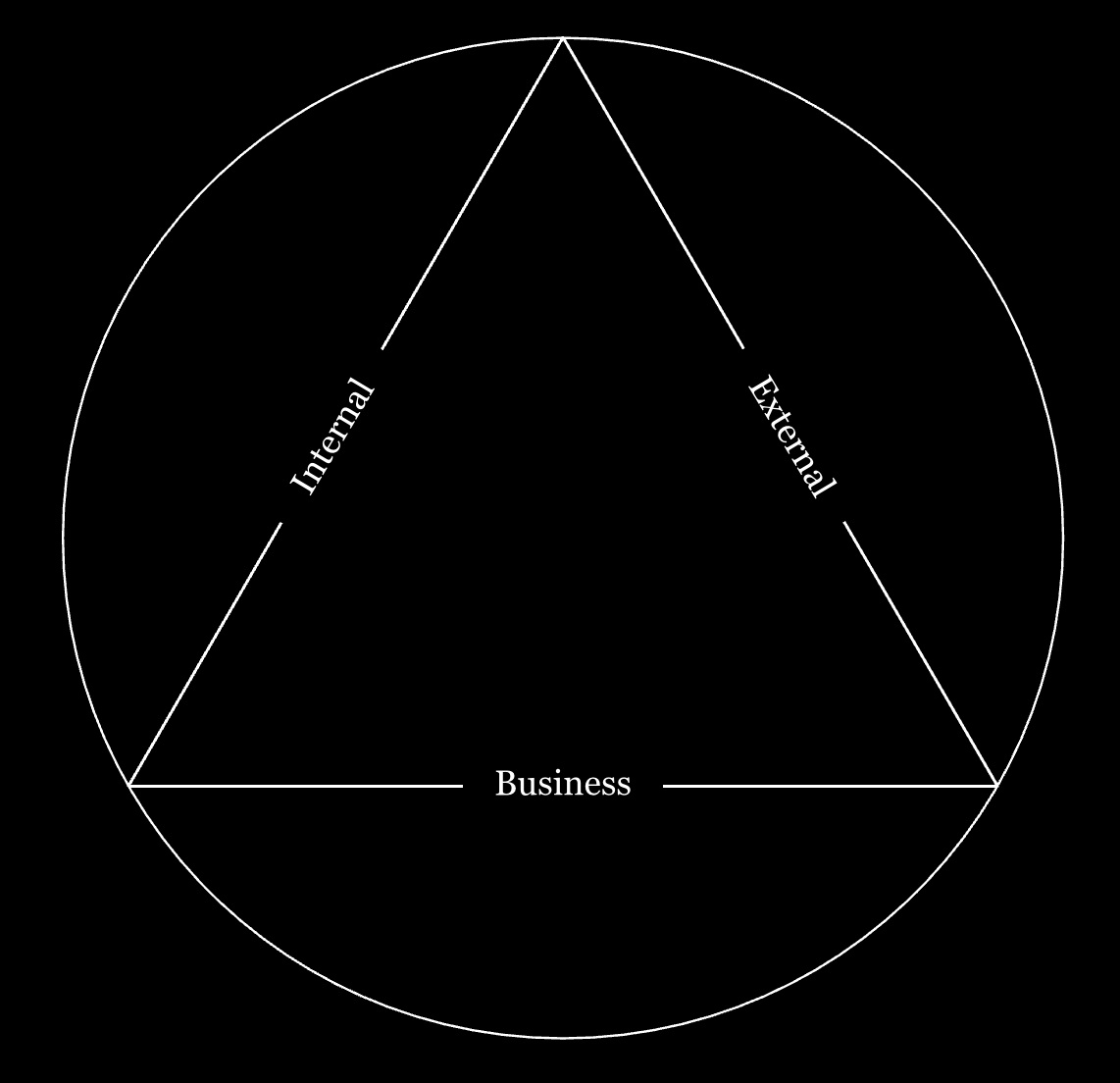
Cohesion is a framework for making decisions easily. Most brands over index on identity or marketing when they really need a compass.
For companies growing out of their initial positioning or pivoting into a different business model, cohesion is a lens to be applied writ large.
Designing for cohesion
Once the ideal is defined, the work becomes diagnostic.
I identify the conditions — technical, social, market-based, narrative, operational, relational — that must exist for that future state to become achievable. Conditions are specific. They are also designable: influenced through signals, experiences, partnerships, proof, and strategic sequencing.
This is where the methodology earns its precision. Beyond direction, condition mapping describes the architecture of arrival — the specific things that must be true, in what order, for movement to happen. A condition might be as concrete as "three lighthouse partners validate the product publicly" or as structural as "the founding team includes someone the investment community already trusts."
The gap between where an organization is and where it wants to be is almost always a gap in conditions, not a gap in ambition.
The diagnostic architecture is sector-agnostic — the same rigor applies whether the context is a fusion energy startup trying to become legible to investors or a hospitality group trying to scale without losing the thing that made it worth scaling in the first place.
3. Preferability
Strategy informed by data tends to follow trend lines — extrapolating from what has happened to predict what will happen next.
This is useful for established markets with clear precedents. It is nearly useless for emerging ones, where the precedents don't exist yet and the trend lines point in twelve directions at once.
Preferability is a different lens aperture. It asks a different question: not "what is likely?" but "what is worth building toward?" A preferable future is specific enough to guide decisions and compelling enough to mobilize partners, talent, and capital. It functions as a design criterion — a way of evaluating choices against a clearly articulated version of what success looks like, rather than against a forecast that may or may not hold.
In practice, preferability is what creates alignment when the data can't. It turns a roomful of competing opinions into a shared direction — not by resolving the disagreement, but by giving it a reference point.
Applied across contexts.
Utilidata
4. Commercialization
The word "commercialization" is often treated as the final step — the moment an idea enters the market. I treat it as the entire journey, and as a design problem in its own right.
In my practice, commercialization is momentum across four interdependent areas: talent — the ability to attract and retain the people who can build what the ideal demands; funding — the capital required to sustain development through the long middle between concept and traction; credibility — the narrative, proof points, and relationships that make an organization legible and trustworthy to the people it needs to convince; and scalability — the structural capacity to grow without losing the thing that made the idea worth pursuing in the first place.
These four areas form the pillars of every engagement. The ideal state defines where an organization is going. Condition mapping identifies what must change for it to get there. Commercialization is the measure of whether it's actually moving — and the design of each pillar is how I make sure that it does.
Utilidata had assembled a team of utility experts, engineers, data scientists, and policy specialists around a genuinely radical proposition: real-time grid intelligence powered by edge computing and AI. The technology was real. The problem was that the sector they were trying to transform — energy utilities — is among the most risk-averse industries in existence. A radical solution, pitched to a conservative buyer, in a market where credibility is built over decades. The gap wasn't technical. It was the entire infrastructure of trust, narrative, and strategic positioning required to make a risk-averse industry take a bet on something new.
I worked with Utilidata's leadership to design a growth strategy that addressed the conditions for traction — not just the product story. That meant shaping a series B fundraising narrative, establishing an Advisory Board to extend credibility into rooms the team couldn't yet reach, identifying and mapping early lighthouse partners and pilots, clarifying a value proposition that translated engineering language into business language, developing product naming and thought leadership, navigating IIJA contract negotiations, and evolving the brand identity to match the maturity of what the company was becoming.
Rhode Island Commerce
Rhode Island's startup ecosystem had spent decades in the shadow of Boston and New York — struggling for recognition, investment, and the kind of momentum that compounds. The conventional approach would have been to benchmark against those markets and close the gaps incrementally. I saw something different: the state didn't need to compete on Boston's terms. It needed a vision ambitious enough to change the conversation entirely.
I applied idealist design at the ecosystem level — setting a preferable future for 2035 in which Rhode Island had attracted $2B in startup investment, a number twelve times higher than its 2023 baseline. From that ideal, I worked backward through the conditions: what had to be true about the state's narrative, its infrastructure, its incentive structures, its relationships with founders and investors, for that future to become achievable. The result was a strategic plan built not on incremental improvement but on condition creation — a roadmap for galvanizing stakeholders around a shared, specific, measurable vision of what the state could become.
Xcimer energy corporation
Xcimer had built a credible path to commercial fusion energy — one of the most consequential engineering challenges of the century. The team was made up of physicists and engineers whose work was technically sophisticated and, to most audiences outside their field, completely opaque. The distance between what Xcimer had built and what the world could understand about it was the distance between a scientific breakthrough and a fundable, buildable company.
I partnered with Xcimer to close that gap — turning a technical solution into a brand. Working with Arvind Bhallamudi on design research and visual systems, we developed a strategic and visual identity that communicated the technology's promise without flattening its complexity, built the narrative architecture to support a $100M Series A launch, and created the storytelling and design systems that would make Xcimer legible to investors, partners, policymakers, and the public.
Hexagon Apex Summit
Hexagon is a global technology company operating across sensor, software, and autonomous solutions. Their CEO wanted to use the company's annual summit not as a showcase but as a strategic tool — a working session with industry executives that produced real thinking, not just networking.
I designed a VIP brainstorming session structured around a specific provocation: how sustainability and profitability could work together to produce measurable outcomes for businesses. The format moved beyond presentation into facilitated, structured collaboration — giving executives a framework to think through a problem together rather than listen to someone else's answer. The session demonstrated something I believe deeply: that convening, designed well, is a form of strategy in itself.
Applied across contexts.
Most people hear "design" and think of something visual — a logo, a layout, an interface. But design, at its core, is the act of making intentional decisions about how something should work. It is a methodology for shaping outcomes. And if that's true, then its most powerful application isn't in how something looks. It's in the decisions that determine what gets built, how it grows, and whether it lasts. That is strategy. And strategy, done with the rigor and intentionality of a design practice, is what I built TNC to provide.
I believe the world would be a different place if design was given credit not as a practice, but as a tool to be used on any number of problems. Imagine if every company had a Chief Design Officer. Or if we elected a Secretary of Design in local government. People whose job it is to think deeply with logic and empathy at the same time. To find universality while still appreciating nuance. To find beauty in the mundane and to improve solutions to problems we might not even realize we have.
Because you can design anything: a chair, a cure, an intersection, an interaction, a menu, a meeting, a feeling. Design is a tool to imagine better, shared futures. Applied, it inspires new ways of living, and new futures to live in. And I intend to do just that.
If this thinking resonates, let’s have a conversation.
alyssa@alyssabishopconsulting.com